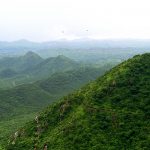
On the heels of the French missionaries who one day took permanent possession of the island, Portuguese officers and administrators arrived in consequence of some political horse-trading; they upgraded the palisaded mission on the southern promontory of the island to a fort, shot a few leading families to ensure good order, and turned the island into a hotter and even more languid Portugal.
The Island Girl
Introducing another gem of Modernist German prose
The German Reich’s brief foray into overseas colonialism between 1884 and the First World War stimulated a crop of imaginative fictions (dusky maidens, faithless natives, intrepid white men), political-philosophical treatises (white man’s burden, racial destiny), and medical-sociological tracts (interracial mixing, tropical sun and northern brains, atrocities medicalised as ‘tropical frenzy’)…
A few years before The Island Girl, the Viennese avant-garde writer and cultural activist Robert Müller had published his major work of fiction: TROPICS: the Myth of Travel (1915; translated 2020), a dazzling tour de force of modernist writing that begins as a Boys Own adventure in search of lost Conquistador gold, proceeds through steaming jungles to an untouched native village where all European preconceptions and prejudices are turned on their head, and ends as an unsolved murder mystery. Filled with outrageous conjectures about evolution, consciousness, sexuality, present and future human types, etc., the overall mood is high-spirited: a very active intelligence having fun with the notions and foibles of civilisation.
The Island Girl, Müller’s second venture into the colonial world, offers a rather different mood. This tautly-written novella presents a collision between naïve preconceptions and a milieu which the protagonist at first finds “abhorrent” (not just the island and its native population, but the residents of the colonial quarter too). Despatched by international authorities to monitor the island’s government following a brutally suppressed uprising, the Belgian Raoul de Donckhard, for all his preparations, has arrived with “everything a European could possess, who as yet knows nothing of the Equator.”
Slotted into a humdrum bureaucratic post, he soon loses his zeal, and adapts to the slow pace of his colleagues. He finds the “dusky maiden” trope is taboo here: on various pretexts (miscegenation; STDs) Europeans are forbidden to form liaisons with islanders – although the Governor himself is hinted to have “illicit affairs”. Instead the island has somehow attracted a bevy of European ladies of doubtful virtue, and wife-swapping is not unknown.
Raoul, tantalised by a glimpse through his telescope of an island girl on a clifftop, is repelled and bored by the Europeans. Eventually he encounters the “island girl” close up, and starts to explore her mentality and her view of the world – though this apparently does not proceed as far as full sexual relations. Formally rebuked by the Governor, Raoul falls into a lengthy fever; is declared unfit for tropical duty, ends up in Chile – where by chance he encounters his island girl, who has been banished, in a brothel. She is the last of her royal lineage.
That’s the outline; but there’s much, much more in almost every vivid paragraph. Take the opening: Raoul’s first view of the island leads him to imagine its entire geological, biological and human past. The story is a continuation of these millennia of natural history. Some images are of almost poetic intensity, e.g. the lances of the Polynesian migrants who first people the island. As they sail, these are held crosswise over the passengers. They are tipped with irregular flint flakes that make them seem to “stare crosseyed like bare tent-poles over the flying campsite”.
Following his suicide in 1924, Robert Müller was almost completely forgotten for half a century; now his Collected Works in German fill some 18 volumes. He remains completely unknown in the Anglosphere, outside a tiny handful of scholars. I hope my translations of The Island Girl and TROPICS will one day repair this deficiency.
Here’s a taster of Müller’s inspired prose:
… THAT was the island’s history. Between the beginning and the present day, no more than a few millennia might have passed. Away over this span of time – charted by learned cassocked Frenchmen in a cell in the palisaded fort after careful researches and time-consuming chains of conjecture – Raoul now gazed, raising and lowering his powerful spyglass. To the unarmed eye the island was as always a bare line of cliffs, the same that had risen from the sea’s depths, stony remnant of a uselessly lovely act of violence by Nature. Through the lens it snapped to a lush but rather rigid splendour, earnest frugal vegetation, a drab nagging tropical landscape.
Raoul de Donckhard trained the spyglass on the island’s trees, on the broad stretches covered with the candelabra plants that always seemed to him the symbol of the island’s most ineffable secrets. Through the lens he climbed ashore, down through the ages into a chock-full cellar into which he had to introduce order – not a natural order, for Nature fabricated her own simple hard ideas, but so he could scrutinise his own thoughts about the island.
He felt a lack of connective tissue between the polished and tractable pattern of his thinking, and the landscape. His thoughts bore the foliage of another zone, they spread out grandly in every direction. His inner life extended in many-stranded convolutions, unlike this island’s tendency towards stark simple strands; his worldview was of a copious in and out of cosmic breath. Like a cockerel facing a chalk mark, he was fascinated by the consequentiality of existence, but also unsettled. For all the tropical lushness, he sensed its poverty and onesidedness, and he came adrift in the first weeks of his arrival.
He found himself in the company of the neutral gendarmerie officers who had been despatched to the island, with the agreement of the American government, to help quell native unrest. Atrocities committed by the Portuguese as they put down the rebellion ran counter to the spirit of the International League of Nations for Colonial Culture. Raoul’s dual mission was as a monitor, and also as an obedient functionary in the Portuguese administration. As a captain in the Belgian gendarmerie he had recently volunteered for the international Congo, to which he had been drawn early on by his Nordic yearning for extremes, and by fanciful changes in his view of life. Now he quickly changed horses. In preparation for his African career he had sought out Portuguese contacts who could provide introductions in their Angolan colony. The notion of being in the Tropics, in direct contact with the wildest Nature and primitive humans, was the passion underlying his preparations.
In January 19xx, when he at last arrived in the Tropics, he had in his possession everything he needed: from the most basic essentials to the acme of fashionable sports gear to a treasure-house of geographic book-learning, as well as considerable qualities of physique: everything a European could possess, who as yet knows nothing of the Equator.
Of course he arrived too late for his principal role. The rebellion, erupting in a manner that his initial impression of such a harmless childish race rendered incomprehensible, had already been put down, and all traces of the bloodbath inflicted by the Portuguese had been erased. It seemed that the islanders’ rebellion had been blown out of proportion by the emotive Lisbon press, and by later reports in the Washington and Boston dailies on the vengeful acts of the island’s overlords. Raoul de Donckhard reported for duty to Governor Don Calgareos; appointed as an officer in the civil administration he was to deal with files, and only the working hours were exotic
He had come as a psychological lion-tamer, expecting to bring to heel monsters with machine guns and a superiority complex regarding human nature. Now he made file notes and wrote numbers in an ink that smelled sour in the heat. Was it this disappointment that led him to despair?
Download The Island Girl PDF
You must be logged in to post a comment.