Since this website went live in April 2018, we have posted the first complete translations into English of five and a half epic fictions by Alfred Döblin, as well as numerous shorter pieces by him collected as a substantial book. We have also ventured beyond Döblin to provide the first opportunity for readers of English to discover the poet Arno Holz, and the Viennese cultural activist Robert Müller. Several shorter translations have appeared in The Brooklyn Rail. This post provides links in one convenient location to my translations formatted as books in PDF format, as well as links to titles already published by mainstream publishers.
 1st German edition (1916) and new English edition (2015) from NY Review Books.The 1st (hardback) edition from Chinese Universty Press (1991) is apparenly still available.
The Three Leaps of Wang Lun (1915) ISBN 978-9622014701
Jenny Williams in the Times Literary Supplement 9 October 2015:
A German novel set in 18 th century China and published a hundred years ago might seem to hold little interest for an English speaking readership today. However, the author in question, Alfred Döblin (1878-1957), pioneered a radical new approach to the novel, which influenced many leading German writers of the 20 th century. … The task of translating The Three Leaps of Wang Lun was clearly a labour of love. The translator, Chris Godwin, has written a useful introduction and included an appendix containing relevant historical material. … Readers prepared to immerse temselves in the noisy, bustling, exotic world of this novel will be richly rewarded, for it is a challenging, absorbing and above all an entertaining book.
Steve Donoghue writing in openlettersmonthly.com on 1 Feb 2015:
… the important German novelist Alfred Doblin’s 1915 fiction debut, The Three Leaps of Wang Lun (Die drei Sprunge des Wang-lun), here in the very muscular English-language translation by C. D. Godwin, who also provides an Introduction in which he’s brave enough to confess that the book is “by no means an easy or a comfortable read” but is very good about the book’s essences:
The uprising of the historical Wang Lun in 1774, an obscure episode that Doblin found in de Groot’s Sectarianism and Religious Persecution in China, provided only the germ for this story of a fictional Wang Lun, this working out of a problem of meekness against force, spiritual yearning against material existence, a mystical sense of the world against the realities of power. Today the truths which motivates the novel can still shake empires.
The book follows martial arts master Wang Lun in his philosophical and sometimes bumbling spiritual quest in 18th-century China under the reign of the Emperor Qianlong, against whose government he eventually leads a doomed rebellion, and Godwin handles with thoughtful ease the signature swoopings of Doblin’s prose from the external to the internal …
The Three Leaps of Wang Lun brought Doblin widespread critical attention, although he’d have to wait a further fourteen years for his masterpiece Berlin Alexanderplatz to bring him both critical and popular attention; it’s the only book by which he’s known today. It’s extremely encouraging to see such a pretty new edition of The Three Leaps of Wang Lun; it’s an evocative brutally self-doubting book and a perfect reminder to serious English-language readers that Doblin wrote a small shelf full of such books (translations of all those books – and of Doblin’s large assortment of excellent nonfiction, including a slew of lively book reviews – would be most welcome, should this volume spark a wave of new interest among the literati).
When Döblin published Wang Lun, he cut four passages. These “outtakes” all appeared during the 1920s as isolated short stories in various publications. The longest outtake – the Prologue – was re-instated in my translation. “Conversation in the Palace of Ch’ien Long” appeared in The Brooklyn Rail in February 2015. The other two can be found on this website.
 Wallenstein (1920).
My revised and corrected 2nd edition can now be downloaded as two PDFs:
A Feast’ and ‘”Dr” Jonas’ (two scenes from Volume 1) appeared in The Brooklyn Rail, 2 November 2017 https://brooklynrail.org/2017/11/fiction/Wallenstein-Extracts
Thomas Lehr, Süddeutsche Zeitung 23 Feb 2002
The war is shown simultaneously on a great narrative split screen. How does AD fill the screens, …? No psychology, no commentary, no narrator murmuring like Thomas Mann ‘deep into the wells of the past’? AD chooses the ‘film style’, with his camera he seeks out material, primal historical material that will overpower the reader, in many places just as he has learned from Flaubert’s great Carthage novel Salammbo.
Eberhard Rathgeb, Frankfurter Allgemeine Zeitung 29 May 2002
These two great figures – Wallenstein and Emperor Ferdinand the Other – would be only black shadows or brittle schemata – if not for AD. Without his furore, his penetration into the historically concrete, his stirring around in the physiological, and his projection of traumatic forces, worldly and other-worldly, without the pounding rhythm of his sentences, sounds and vividly evoked moods. Without AD’s linguistic adventurousness that tailors words into people, without his passion and his sense of the chaos of wanting and wishing and the unbounded savagery of the life urge, these two figures around whom everything revolves might have become characters with feet and a head, but for sure they would have lacked all transparency for the currents that move not only them. They would be figures, not eruptions of historical Nature. What should one still believe in? In the righteous deed, which however is drowned in the tumult of unrighteousness.
Mountains Oceans Giants (1924)
Max Krell, Die Literatur 26 (1923-24)
In Mountains Oceans Giants we have arrived at a point where humanity and natural forces confront each other on almost equal terms. And so it’s no longer an Utopian thriller such as those that seek out some farcical notion – how one reaches the Moon, for example, or the centre of the Earth – it’s a novel about the human race in a decisive battle against Nature, it’s the first step in the great battle between Physis (Nature) and Genius, and about the meaning of Existence. … Döblin works with very extensive timescales; centuries are crumpled together, you lose any reverence for the year and the individual …
Ernst Blass, Die neue Rundschau 35 (1924)
Döblin’s books remind of limestone caverns: half-formed figures, and behind them Chaos. His Chaos is no overt blooming confusion, but people come along, progressives, organisers, warriors against Chaos, they almost overcome it and yet lose themselves again in the universal whirlwind …
Everything is exact and yet confused. People, their drives and fates are analysed and described with verisimilitude … but then strange, monstrous incomprehensible unspeakable secrets begin …
A mighty book that will be read, studied and interpreted for decades.
Klaus Müller-Salget: Alfred Döblin – Werk und Entwicklung (1988)
Those who speak of the “stony soullessness” of this maligned novel merely reveal their own western anthropocentric world view. For many passages rise to a hymnic adulation – not admittedly of humans, but of Nature, the sun, the ocean and its currents.
Mountains Oceans Giants and Manas are now published!
The UK publisher Galileo has done an excellent job of book production on these two translations, which are now available in print and as e-books.
Mountains ISBN 978-1-912916-24-5
Manas ISBN 978-1-912916-21-4
Excerpts from both translations were published by The Brooklyn Rail in 2016. Check them out to get a taste of two very different examples of Döblin’s art!
http://intranslation.brooklynrail.org/german/mountains-oceans-giants
http://intranslation.brooklynrail.org/german/manas-a-himalayan-epic
Parts 3 and 4 of Mountains have been abridged, for reasons explained in the Introduction. The omitted passages can be downloaded as a pdf : 43 pages/950kB.
MANAS (1927)
Oscar Loerke: ‘To Alfred Döblin on his 50 th birthday’ (1928)
The basic course of events in Manas – for all the overwhelming profusion of invention in its scenes, characters, profound character traits of gods, demons, people, animals – is of an overwhelming simplicity … Döblin’s greatness lies in attempting to seek the measure of the immeasurable. He sings the power of the Soul, which in its human shell becomes all-powerful. … He has created a gripping fable. … Manas poses enormous questions: What is Life? Death? The Soul? … Manas as a man and Savitri as a woman break through the boundaries of the individual to grow into the embodiment of Humanity. Savitri becomes the goddess she was before she came down to Earth, and stays in Heaven; Manas lives on on Earth, a Superman freed by ultimate knowledge – a Super-god.
Axel Eggebrecht, Die literarische Welt 3/24 (1927)
Again we stand astonished, as with Mountains Oceans Giants, at the inexhaustible power and breadth of Döblin’s brain. Even more moving are the inward sweetness of the most tender trifles, diversions into fairy tales, dreamily specific views of landscapes and souls with which this immense colourful hefty web of absolute phantasy is shot through. In it there are little sagas, Indian, maybe retold but in the retelling wonderfully renewed; amid this opulence of a conscious phantasizing intelligence are sections full of unparalleled surrender to landscapes, deserts, mountains and seas. And it ends in such jubilant wild triumph over the narrow sense-bound world that even the sober reader is pulled along …
Robert Musil, Berliner Tageblatt 10 June 1927
It is neither caprice nor chance, but extraordinarily revealing of Döblin’s nervous intensity, … the boldest move, and one requiring the most radical commitment, to simply go back to earlier verse narratives in order to make that ancient holy turtle move at today’s pace. You can’t say he gets away with it lightly – pious preservers and aficionados of the strict heavenly epic forms will cover their heads in horror – but it happens with a marvellous relentlessness that has great pulling power in even the smallest details. … The realism with which humans, super- and sub-humans, gods, the dead, demons, real and unreal events are described is as exact as an observation and as cruel as the fact that all flesh carries within it the ribs of death. Against and over one another these pitiless descriptions, the lyrical beauty of which is Döblin’s surprise, pile up to a wildly decorated tower.
***
My adaptation of Manas as a Play for Voices can be downloaded as a pdf: 150 pages/2.3MB
THE AMAZONAS TRILOGY (1937-38)
Werner Stauffacher, Afterword to the first unified edition of the trilogy (1988)
So the theme of this ‘narrative work’ is not only ‘South America’, but also, and at least to the same extent, ‘Europe’: the Europe of worldwide expansion that began in the 16 th century and was coming to its end in the 20 th. More precisely, the relationship of this expanding Europe with the rest of the world: the world of before, and the world of the other. The work raises questions about the rationale and irrationality of recent history under the sign of Euro-centrism, from the viewpoint of an author who, as a German-Jewish émigré, was about to be evicted from this world-centre to find himself suddenly displaced into the role of the ‘other’, with a growing awareness of the Age of Europe’s problematic and transient nature.
Volume 1: Journey to the Land without Death
(June 2018): 188pp / 2.5MB Downloads disabled pending book publication in October 2022
Volume 2: The Blue Jaguar
(July 2018): 254pp / 2.7MB
Volume 3: A New Jungle
(July 2018): 118pp / 1.4MB
NOVEMBER 1918 – A GERMAN REVOLUTION (1939)
VOLUME 1: CITIZENS AND SOLDIERS 1918
PDF download, 257 pages, 3MB.
The two-volume translation by John E Woods, published by Fromm in the 1980s, was seriously incomplete. Not only was Döblin’s first volume (Bürger und Soldaten) entirely missing, but some 200 pages were cut from the subsequent texts.
The missing passages are now translated in two posts:
Set 1 (short miscellaneous pieces)
Set 2: Stauffer and the Women. A Novella.
GERMAN MASQUERADE: Writings on Politics, Life and Literature in chaotic times
This, the first selection in English from Döblin’s enormous output of non-fiction writings, presents three dozen pieces written between 1905 and 1949, in four parts:
Part 1: Pre-War and Aftermath includes an excerpt from the thesis that qualified Döblin as a doctor (which raises intriguing questions about the fabulations of lunatics and novelists), early examples of Expressionist prose, and four post-War essays on current affairs under the pseudonym ‘Linke Poot’ (Left Paw).
Part 2: Politics and Society includes wide-ranging reflections on techno-society (‘The spirit of a naturalistic age’ and ‘Prometheus and the Primitive’), as well as robust commentary on the Jewish question and left-wing literary commissars.
Part 3: Life includes the most significant autrobiographical writings, notably the extraordinary ‘A first look back’ and Döblin’s letters describing his year in Hollywood (1940-41).
Part 4: Literature includes Döblin’s most important essays and lectures on fiction, the Epic, historical novels, and being a writer.
Download German Masquerade pdf, 281 pages, 3.6 Mb.
ROBERT MÜLLER’S TROPICS – THE MYTH OF TRAVEL
Robert Musil: “…a remarkable blend of the Utopian and that which merely passes for Utopian… The animal power of the fantastical river journey in the jungle… this book is one of the best in modern literature.”
Hermann Hesse: “…the boldness and pliability of the mental action … the plenitude of linkages, points of view, associations is deeply impressive.”
Alfred Doeblin: “On one page as much happens as previously in a whole book. Mueller is a dazzling wordsmith.”
Kurt Hiller: “…the unprecedented crossing of a Gauguin and a super-Freud, with a dash of cocky sport-boy. Or of Nietzsche and Karl May.”
After Mueller’s untimely suicide in 1924, his writings (now resurrected in some 14 volumes of collected works) lay forgotten for over half a century, until a new generation of Germanists began to explore them in the 1980s. For the past three decades there has been a growing stream of scholarly articles and monographs on this novel in German, yet Mueller remains entirely unknown in the Anglosphere.
The novel is remarkable on several levels:
- It turns deftly on their head many cherished beliefs and ideologies current in pre-WW1 German-speaking lands (and in the West more widely). The myth of a civilising colonial power; the myth of the intrepid explorer/ethnographer dealing honourably with devious natives; the Romantic myth of the Tropics, with on the one hand sundrenched palms and willing maidens and on the other blank spaces on the map ripe for European exploitation; the myth of the benevolent European administrator or entrepreneur, whose brutality once freed from the inhibitions of European society is medicalised as “tropical fever”. In short, it questions every dogma about Eurocentric civilisation and barbarism.
- It contains several levels of fictivity, from the framing ‘Editor’s Foreword’ by a fake ‘Robert Mueller’ to the ever-growing puzzles about what in the narrative is real, or imagined, or dreamt.
- It mixes genres: starts as a Karl May-style exotic adventure, proceeds with a dual layer of (anti-)exotic surface action and philosophical speculation, and morphs into an (unsolved) murder mystery.
It all works because of the astonishing vigour of Mueller’s language, imagery, and narrative drive.
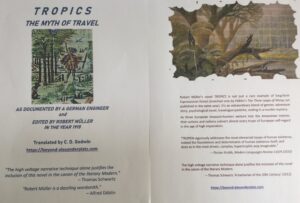
Download TROPICS – THE MYTH OF TRAVEL
ARNO HOLZ: PHANTASUS
Translations of the complete 1898-99 edition, with a selection from the much expanded 1916 edition.
In the 1898-99 Phantasus, Arno Holz attempts to construct via lyrics a world-picture comprising succinctly sketched details of a stream of consciousness, test samples from flowing water, the reservoir of motifs being virtually without limit:
The new ‘world-picture’, for which almost all lyricists of this era strive, is not to be achieved by reverting to the archaic, but by an ever stronger splintering and faceting of all attainable complexes of knowledge and feeling, whether dreams, visions, instinctual impulses, concrete experiences, reminiscences, the scientific, the religious, even the everyday. The whole thing is a first attempt to lay bare the consciousness of all the varied realms of experience, in their unsorted juxta- and super-positions; corresponding at some distance to Freud’s attempts in The Interpretation of Dreams (1900).
– Jost Hermand, Introduction to the 1968 Johnson Reprint edition
of the 1916 Phantasus
Holz wanted his poems to be read out loud, but he feared that few readers would be capable of hearing their full power. According to Holz, poem “Myth of Power”, expanded in the 1916 Phantasus, from little in the 1898-99 edition, is:
nothing less and nothing more than a musical score, which should therefore be not read but performed. And if there is as yet no performer … one day he shall appear! I see him facing a darkened hall, walled in by heavy folded curtains, seated on a timeless curule chair of power, in a costume just as timeless, the changing expressions sharply illuminated and not only his word speaks, his tone, his voice, … the whole man, his slightest gesture, his minutest movements.